"I all became true, everybody I spoke to about the route Kinshasa - Lubumbashi said just one thing: 'You will suffer', and we did..."
Matadi, the day before we left
Congolese traffic
Lucky they are not driving very fast...
...or this happens
From Kinshasa to Kikwit is asfalt
end of the asfalt at km 622, thanks Kabila
The first days from matadi to Kinshasa and then Kikwit were spent on perfect asfalt and I tried to enjoy it to the fullest because I was fully aware of what was to come. My thoughts drifted away to Anita, who got her Angola visa and was now on her own travelling down towards home in Namibia, but I was hopeful to meet her in a few weeks from now.
At the end of the first day we arrived late in Kinshasa, and fueled up just before dark. We planned to camp just after Kin but got stuck in the most unpleasant city experience I ever had. Traffic was completely jammed, with 4 lanes of cars trying to leave the city over a half asfalt/half sand messed up road with some concrete blocks lying around randomly. By now it was dark and with no streetlights and thousands of pedestrians crossing the traffic in the dusty chaos, it was just scary, and a shame I have not shot any video. Regis car was rammed and I almost came of the bike driving through a sandy patch but we made it out of the city and stumbled upon a perfect camp place. Nervous first day.
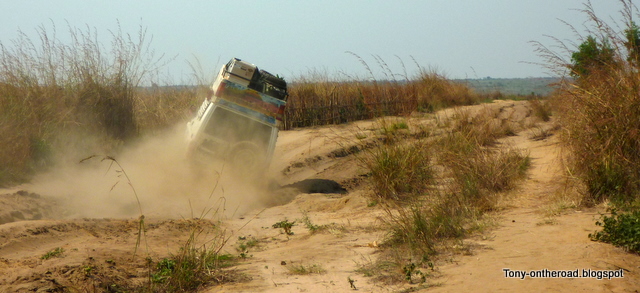
Regis came close to tipping the car several times
100 km after Kikwit it all starts. When we looked at the piste just meters from the end of the asfalt it was apparent it was going to be difficult, and promply decided we would detour via Gungu, which was easier according to the locals. It was not. Pretty soon I was struggling with the fully loaded bike on the sandy truck ruts and I gladly accepted Regis offer, who is also a bike rider, to put the heavy sidecases in the car.
This made a huge difference but still I worried about the lenght of the road to come, will it all be as hard as this?
Dry season - Lots of sand
Lucky for me it was not this hard all of the time, the first 2 weeks I actually had some fun too. It was certainly harder for the car drivers, their cars too narrow to drive into the deep truck tracks, they had to negociate the terrain carefully and slowly. They got stuck many times, and we started keeping scores on the side of each vehicle. Sometimes the sand plates were used, other times Regis' winch, or we just pulled one car with the other one, but the going was slow, I was spending a great part of the day just waiting.
One of the 15 checkpoint around Tshikapa
First 1000 km were like this
The people were also a challenge, their constant demands for money, as soon as they see a white person, became irritating after just a week, and at the campsites every evening we tried another technique. When people stopped and said 'bonjour', we would just ignore them. Not nice, but it worked, because as soon as you say something to them, the demands start, donne moi si, donne moi ca,...they would go on and on without any shame or sence of privacy.
We were delighted however that after Mbuji Mayi, the people changed dramaticly, they were a lot friendlier and we could have whole conversations without any demands, the whole atmosphere in the cities changed too, we were no longer mobbed, like in Kanaga, where we literally had to flee the city, but were left alone to do our stuff, while people watched curiously from a distance.
Playfighting , we encountered no agression, just a lot of demands for money.
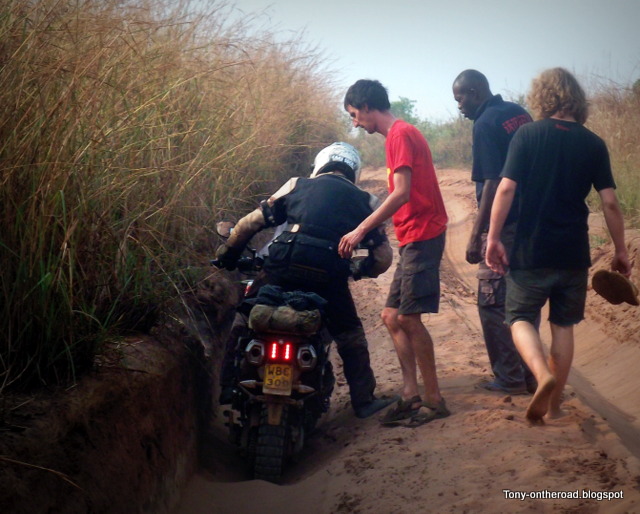
The real hero's, the bike pushers!
The convoy
Tshikapa repair
Tshikapa is about the worst piece on the route and for 3 days we took a guide with us to show us the detours through the villages and the bush, he prooved helpfull, but for the bike it was not realy neccesary as I mostly could follow the push bike tracks and even go driving into the truck tracks, which in the dry season proved not too hard to drive, although my feet were scraping the hard sides of the tracks, and the risk of breaking an ankle was real.
The sacks are local coffee
Regis drinking cola on his first day of malaria
At lac Mukamba Regis came down with malaria and we spent 3 days resting and washing our clothes in the cristal clean lake water on the grounds of a de-mining company, which was a lot cheaper than the catholic mission, who asked 20 dollar for a room without electricity and running water.
Fuel prices were at an all time high by now, close to 3 dollar for a liter, this, combined with the abnormal high consumption of the vehicles, made fuel pump visits painfull. Regis got his Landcruser to consume 30 litres of gasoline per 100km, my bike saw record values of 7 litres/100km.
Most of the bridges are in excellent shape or just newly build as part of Kabila's 'cinq chantiers' but this one was dammaged by a passing truck. It was quickly solved by placing the sandplates however.
The second part of the trip, after Luputa, the road changed into rocky ground with a different kind of sand, the kind they call 'FeshFesh' in Morocco, and is a powder like dust, which covers the whole road and leaves dustclouds that keep suspended in the air for minutes, so we started driving with more space in between the cars to spare the airfilters. The road was following the railroad and was in bad shape, some places resembled a moto-cross circuit and were barely passable for the cars. One of the biggest dangers became concentration, one second was enough to be steering right in to a big hole, or over a big stone, like Thomas and Claus' Landrover when they hit a big one, which bent the steering bar, but the sturdy Landy was still drivable. The scores for getting stuck were by now Mercedes 20 times, Landcruser 15 times, Yamaha, 4 times and the winner, the Landy with only 2 times.
Working train between Mwenu Ditu and Lubumbashi
2750 francs congolais or 2,5 euro per litre
Waiting for the cars again
For days we were talking how dangerous lack of concentration was on the piste, and in the last stretch it almost resulted in tears for me. I had a bad nights sleep, puked out my dinner around midnight, and felt complete powerless when I started on what supposed to be the last day offroad. At km 65, I had a first warning, when a byciclist stayed in the middle of the road just staring at me, and I hit a big hole trying to avoid him. The front wheel caught air and sent the bike into the bush. The worrying thing is that I didn't see the hole at all. Just 7 km further on, at km 72 that day, and just as I was thinking how I could have easely broken my leg with that crash, I was taken out again.
Trying to avoid a bicycle rider...
I was following the main truck track going through a sandy pit, no different from the million ones I crossed allready, when in a split second the bike went down to the right, catching my ankle under the rear fork and sending me into instant pain. I broke some bones, but never felt pain in the first 30 minutes, this time, I was screaming it out. Problem was that I was pinned down and couldn't get the bike of me, but then the universe was gentle with me, and sent 3 doktors in a car just one minute later. It was the 2nd car I saw that day, and quickly they declared that they were doktors and that the leg was not broken. It was clear however I was not going anywhere anymore that day and while I waited for the painkillers to start working, I hoped I could drive the next day.
Next day I my ankle was good enough to try to drive, and at 15 km/h I started to drive the last bit of piste.. Soon the road improved and we were all extatic to reach the asfalt today, cause that would mean the end of the suffering. We did eventually reach the asfalt, but the first bit of main road towards Likasi was appaulingly bad, even worse than the piste the day before, it was the last sting this road delivered, it was over, we did it, the vehicles were still running, we were alive and well, and only 100 asfalt kilometres away from Lushi....
Never again, enjoy the video:
This is a link to a kmz file in which you can see the actual route on Google Earth:
Today was our last chance to get the Angola visa. We were summoned to the embassy, together with our group and the vice consul of Belgium to speak to the vice consul of Angola. Innitially the vice consul was very possitive and he realy wanted to help us get the transit visa, but after a few phonecalls it was apparent that he could do nothing. Because of the elections in august in Angola, all transit visa's were blocked, the only option for tourists is now to get the visa in the home country, and this was no option for our group, now 5 people from different countries, as it would take too long and cost too much. Most of us were allready more than 2 weeks in Matadi so we needed to make a decision. Luckily Anita got her visa sent by DHL today from Namibia, were she is resident, but the rest of us are condemmed to the long and hard Kinshasa - Lubumbashi road. Once in good condition under Belgian rule in the 50'ties, now only accessible during the dry season by some trucks and pushbikes. It is regarded as one of the most difficult roads in the world and our only advantage is that all of us researched this road for some time now. My friends (www.roamingafrica.be) did this road last year and their gps track will be our guiding line through the DRC, 2000 km towards Lubumbashi and then onto safe and modern Zambia.
Tomorrow morning we will leave, not stopping in Kinshasa, to make our way round Angola and it's retarded visa pollicy. This time, my fear outweights the excitement big time, it won't be easy. Expected next blog entry: in at least 3 weeks. Wish me luck!
From Dolisie, we made a 4 day tour to Pointe Noire to get some repairs done on Thomas' car and in the mean time, try our luck at the Angolan consulat. As expected, the consulat didn't even let us in, saying that no tourist has got the visa there, ever! With the repairs done we returned for a short stop in Dolisie and then went onto the piste towards Mindouli, where we would turn right to avoid Brazzaville and Kinshasa alltogether, as the ferry between the 2 countries is often referred to by overlanders as ' the worst experience of the trip' and we heard stories of tourists being put in jail on the Kinshasa side for no apparant reason.
Congo looking to the border of DRC
Mindouli trainstation
The piste turned out to be alright and posed no problems now that we arrived in the dry season. Once we got to Mindouli, we had ourselves stamped out of the little Congo and were on our way to the dreaded DRC border.
Towards the border post
We had some trouble finding the little road into the mountains towards the border post and again we spend hours inbetween borders, strugling with badly rutted steep inclines before we arrived at the tiny post of Nzala, where we changed some money and nobody even mentioned the fact that we got our visa in Gabon and not in our home country. We were put onto the right grass overgrown track towards Luozi by the border people and arrived a little later at the family of mister Fidel at Moutanga Ntende, where we spent our first night in Drc.
It took us two more days to arrive at Luozi along beautifull but hardgoing pistes, but as my bike suddenly and mysteriously consumed 50 % more fuel, I ran out of petrol just 20 km short of town centre. Luckily Thomas had some 2 stroke in his generator, which worked fine. The DMG (immigration services) where already waiting for us as they were telefoned from another village we crossed, and this time they made us pay 10 dollar for filling in the information form, witch we reluctantly paid after getting a receipt. We would soon learn that the DMG would turn up just everywhere, even at a mountaintop bush camp, but mostly they where friendly and just wanted to write down our names.
Webcam fun
In Luozi, Thomas decided to take the ferry, and me and Anita took on the piste that stayed on the North of the congo river as the scenary was just unbelievable and the roads were challeging but not too hard.
Bit muddy, otherwise fine...
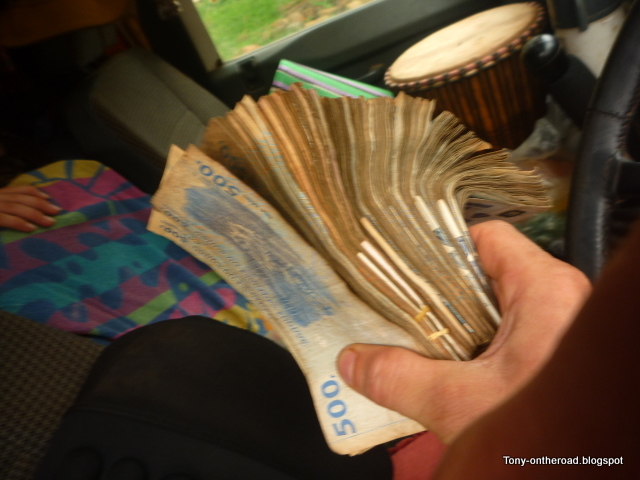
160 euro worth in Congolese Francs
We even spent an extra day just camping in the mountains so it took another 3 days to finally arrive at the bridge over the mighty congo at Matadi.
Pushbike, the main transport of goods to small villages
Not going hungry on the piste
DRC holiday
No phone reception all the way to Matadi
In Matadi, which proved to be quiet larger than expected, Regis, our French companion, was getting the visa formalities sorted, as he was there for already more than a week. He made good friends with a lady who worked in the embassy of Angola, but as the embassador was out on holiday, we had to wait till next week.
Matadi
Best campspot ever
Matadi by night, having some fun with long exposure shots
Boma, looking at Angola at the other side
As we had some time to kill, me and Anita went out of town, first to Boma, but as that was a bit of a disapointment, back towards Matadi, into the mountains that overlooked the city. When checking out a little village near the river, and as we both were out of the car admiring the view of the congo, some kid reached into the car and stole my Ipod. I only realised it that evening and the next 2 days we visited the village to find a solution.
At this moment, my Ipod was swiftly grabbed from the open car
It was a bit surreal, the whole village knew about the theft, but explained it was already sold and they could do nothing, but after talking to the village chief, a big mama and some staged drama, the next day the Ipod turned up again, and I paid them a little compensation, as the story was the mama had to buy it back with her own money and the thief was on the run. We didn't let it get to us as we found a real perfect camp place on top of the mountain, overlooking the little thieving village and the bright and big Matadi.
Last news: well nothing, still waiting to get permission to apply for the Angolan visa ....